Five habits to build real bedside mastery in 2025.
In the last newsletter, I made the case that POCUS doesn’t kill the physical exam – it rescues it.
Used effectively, ultrasound pulls us back to the patient’s bedside, instead of deeper into the physician workstation.
This week, let’s get practical.
If you want to feel more confident and effective at the bedside in the next few weeks…
…you don’t need a new rotation, a certification, or a massive time investment.
What actually moves the needle is much smaller — and completely realistic for a busy clinician.
A short list of repeatable bedside habits that line up with how physicians truly build skill.
Here’s the part we don’t say out loud often enough:
The brain improves through frequent, low-friction reps, not big blocks of time.
Procedural memory — how your hands move, how you position a patient, how you sweep a probe — strengthens fastest with brief, repeated moments of practice, not weekend courses.
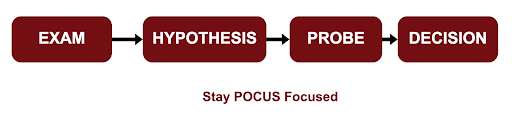
Pattern recognition gets sharper when your exam → hypothesis → probe → decision loop is used again and again on real patients.
You can feel the difference within a few shifts:
Your exam becomes more targeted.
Your working diagnoses tighten earlier.
Your probe use becomes more disciplined.
Your conversations with patients become clearer.
Your uncertainty decreases — not by magic, but by reps.
This isn’t about being “perfect” at ultrasound or exam maneuvers.
It’s about building a fast, reliable bedside loop you can run over and over.
Once those micro-habits start stacking — even in small ways — your clinical day starts to feel different fast.
Habit 1: Start with the story, not the screen
When you’re rushed, it’s tempting to reach for the probe (or the order set) before you’ve really heard the story.
First, try to connect with the patient:
Sit down or stand at eye level.
Ask one clean, open question: “What’s worrying you the most right now?”
Let them talk for 30–60 seconds without interrupting.
Secondly, examine the patient.
Then pick up the probe.
What changes:
Your pre-test probability sharpens.
Your scan becomes targeted, not random.
Patients feel seen, not “processed.”
Micro-challenge: For your next shift or clinic half-day, pick 3 patients and consciously delay touching any technology (ultrasound, keyboard, or charting) until you’ve heard their story and completed a focused exam.
Habit 2: Make a 2-minute “bedside loop” your default
Bedside mastery is less about heroic moments and more about a repeatable pattern that becomes a habit.
Here’s a simple loop I teach:
Look – observe work of breathing, distress, color, and positioning.
Listen – 2–3 focused questions that refine your hypothesis.
Lay on hands – one targeted physical maneuver that must inform your next decision (JVP, lung bases, abdomen, dependent edema, etc.).
Lay on the probe – one focused POCUS question that actually matters for this patient right now.
That whole loop can be done in under two minutes once you’re practiced.
What changes:
You stop “just listening to the lungs” and calling it an exam.
Your POCUS use becomes disciplined: one scan answering one question.
You leave the bedside with a clearer working diagnosis and a better sense of trajectory.
Habit 3: Narrate your thinking out loud
We radically underestimate how confusing medicine looks from the pillow.
You can turn every bedside encounter into a micro-teaching and reassurance moment by narrating what you’re doing:
“I’m checking your neck veins here—this helps me see if your heart is backed up with fluid.”
“These lines I see on ultrasound can mean extra fluid in the lungs. In your case, they’re mild, which fits with what we’re seeing on the exam.”
This does three things at once:
Calms anxiety by making the invisible visible.
Forces you to connect physical exam, ultrasound, and plan into a coherent story.
Models clinical reasoning for learners in the room.
Bedside script to borrow:
“Here’s what I’m seeing, and here’s what it means for you right now.”
If you say that sentence at the end of every POCUS-informed encounter, your patients will experience much more clarity.
Habit 4: Close the loop before you leave the room
Most of the “they never told me what was going on” complaints patients and their families make are not about bad intentions — they are about half-closed loops.
Before you step away from the bed, try a three-part close:
1. Name the working diagnosis or question.
“Right now, this looks most like your heart struggling to keep up, but we’re also keeping an eye out for infection.” 2. Name the immediate plan.
“Next steps: we’ll start diuresis, keep monitoring your breathing, and I’ll follow your labs and ultrasound over the next few hours.”
3. Invite one question.
“What’s the one thing you’re most worried about that I haven’t addressed yet?”
Once this is a habit, it takes less than a minute and dramatically reduces anxiety and confusion — for patients and families, and honestly, for the clinical team as well
Habit 5: Build tiny POCUS reps into every shift
You don’t need a month-long course to improve. You need reps with feedback.
Here’s a realistic structure for you as a busy clinician:
Pick one core application for the next 4 weeks (e.g., lung for dyspnea, basic cardiac for hypotension, or FAST in trauma).
Commit to 3–5 scans per shift where you:
Have a specific clinical question.
Save the clips.
Write down your impression in one sentence.
Once a week, review a small batch of those clips with a colleague who’s a little more advanced — or compare your read to a gold standard (formal echo, CT, clinical outcome).
That’s it.
Fifteen to twenty intentional scans per week over a few months will do more for your skill than 300 random “because the machine was there” scans.
Putting it together
If Part 1 was about the why — why bedside medicine still matters and why POCUS belongs next to the stethoscope, Part 2 is about the how.
You don’t have to overhaul your practice. You just have to:
Start with the story, not the screen.
Run a fast, disciplined bedside loop.
Narrate your thinking for patients and learners.
Close the loop before you leave the room.
Stack small, focused ultrasound reps over time.
If you choose even one of these habits and stick with it for the next month, your bedside presence will feel different — to you, to your learners, and most importantly, to your patients.
Quick Reflection for Your Next Shift
Pick one:
“Which of these five habits am I already doing sometimes, and how could I make it intentional?”
“Which habit feels most uncomfortable — and what tiny version could I try once tomorrow?”
What would you like to see me take on in future issues?
What has your attention right now in your POCUS practice?
Best,
Bob
PS: If you want structured ways to build these habits into your year, we’re lining up new quick-reference tools and case-based modules inside POCUS Focused that walk you through exactly this kind of bedside loop. More on that soon.
Holiday Sale
PSS: You might still have time to take advantage of our limited POCUS Focused Access Event. This once-a-year offer of 20% off all our subscriptions ends December 3rd at midnight EST and includes an exclusive set of new digital reference tools to support your bedside practice.
Dr. Robert Jones, DO, FACEP— a nationally-recognized educator and front-line emergency physician — has dedicated his career to advancing POCUS from “novel tool” to standard practice. From launching ultrasound fellowships to authoring curricula and training thousands of clinicians worldwide, he blends over 30 years of high-volume trauma experience with proven teaching skill to shape the next generation of point-of-care innovators.
"Armed with the knowledge and techniques obtained from your school, I feel more equipped to navigate the challenging social aspects of the real world and become a professional in my field of choice."
Sue Porter
"I would definitely recommend your school to anyone hoping to pursue a career and be a professional. The support they provided to their students was simply outstanding and the genuine interest and care was obvious and incomparable."