
How to Measure Your Own POCUS Progress in 2 Minutes a Week
Last week, we focused on the power of narrowing your attention to a single exam.
This week builds on that idea by offering a simple way to notice when that focus is actually paying off.

The Problem Most Clinicians Don't Name
If you’ve ever had the sense that you’re doing POCUS but aren’t quite sure whether you’re actually getting better, you’re not alone.
Most clinicians don’t stall because they lack motivation.
They stall because they have no feedback loop.
I’m not suggesting formal assessments or super detailed logs.
Just a simple way to answer one question:
Is this working?
Why Progress Feels Invisible
POCUS improvement rarely announces itself.
There’s no clear milestone when image acquisition suddenly feels easy.
No banner moment when confidence clicks into place.
Instead, progress happens quietly — and if you’re not paying attention, it’s easy to miss.

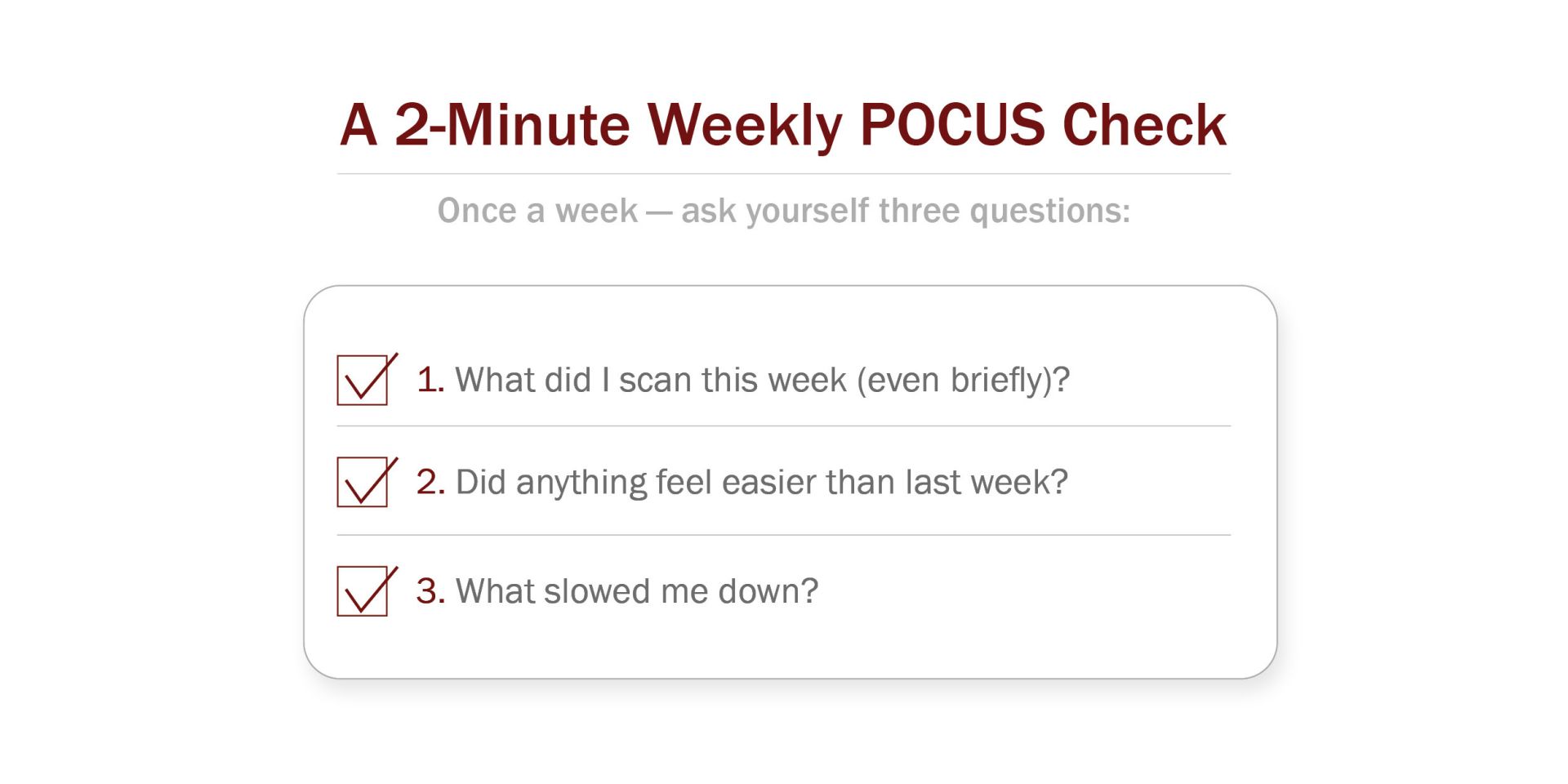
A 2‑Minute Weekly POCUS Check
Once a week — ask yourself three questions:
1. What did I scan this week (even briefly)?
2. Did anything feel easier than last week?
3. What slowed me down?
No spreadsheets.
No scoring.
No pressure.
Why This Kind of Tracking Accelerates Clinical Confidence
Pattern recognition strengthens
When you briefly reflect on what you scanned and what felt easier, you reinforce emerging patterns.
Your brain starts to recognize anatomy, probe positions, and image cues faster because you’re actively naming what’s changing — not just repeating motions.
Cognitive load decreases
Uncertainty is mentally expensive.
A simple weekly check reduces background noise by clarifying what you already know versus what still needs work.
That frees up bandwidth at the bedside, where decisions need to be made quickly.
Confidence becomes grounded
This isn’t hype-based confidence or “feeling good” about ultrasound.
It’s confidence anchored in evidence — small, real improvements you can point to.
That kind of confidence is steadier and less vulnerable to bad days or difficult patients.
Learning stays tied to real patients
Because the reflection comes from actual scans, learning remains clinically relevant.
You’re not studying in abstraction; you’re integrating ultrasound into your everyday decision-making, where it matters most.
Looking Ahead
January isn’t about intensity.
It’s about clarity.
Simple systems.
Realistic expectations.
___________________________________________________________________________
Before you click off … Are you looking for a quick, reliable bedside reference for abdominal aorta scanning?
I’ve created a one-page Abdominal Aorta Cheat Sheet that acts as a practical visual you can use during clinical work.
You can download it for free on our website.
If you know a colleague for whom you think this would be useful, please feel free to share this resource with them. As a growing educational business, I truly appreciate your help in passing along resources you find useful!
___________________________________________________________________________
Lastly, most of us are more time-compressed than ever. Long study sessions aren’t realistic, but completely stepping away from POCUS doesn’t work either.
I’m exploring a simple weekly POCUS case of the week — one case, one question, just enough to keep pattern recognition active without adding burden.
If that would be useful to you, you can register here to receive updates:
Until next week,
Dr. Bob Jones
DrBob@pocusfocused.com

Company
Learning
Connect
-
PO Box 23038Chagrin Falls, OH 44023
-
support@pocusfocused.com